If the Glass Slipper Fits…

Once upon a time...
There was a child named Cinderella, or Ashpet, or Moss Gown or Yeh Shen, or Cinderlad, or Chinye, or Jouanah, or Little Gold Star...
Over 1000 Cinderellas from all over the world have enchanted listeners for centuries! What better story to be the star of the first issue of Imagination on the Move 2.0 ?! (What was Imagination on the Move 1.0, you ask? Read all about it in our blog!)
This month, Little Gold Star is taking center stage!
Like most fairy tales, Little Gold Star is a shining model of the ordinary magic of resilience. From the complex family relationships, to the heroine’s initiative and self-regulation, the story offers children an engaging way to see the protective factors for resilience in action.
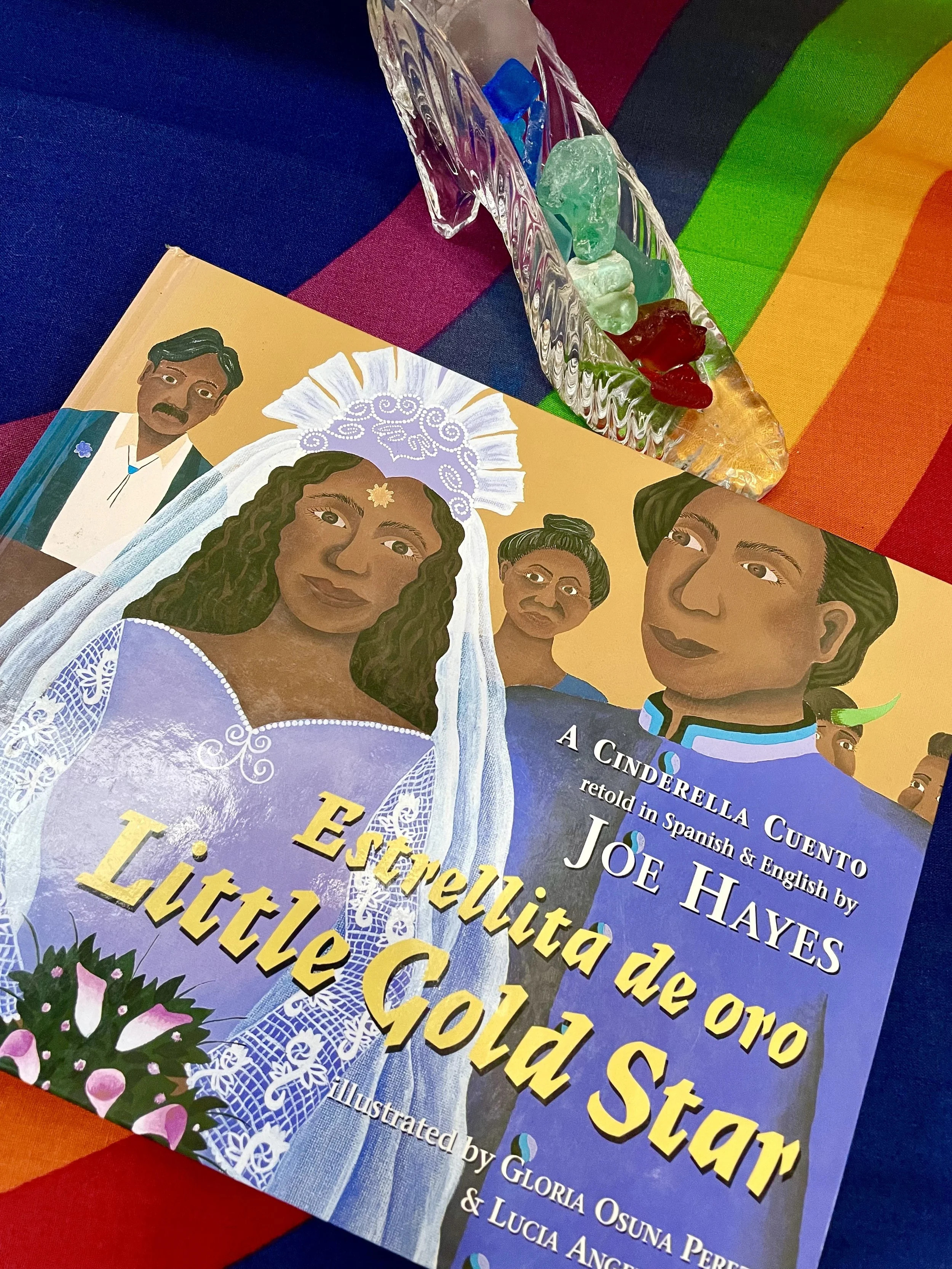
Why Little Gold Star?
Storyteller Joe Hayes collected this Cinderella cuento from storytellers in the mountains of New Mexico, and it has the flow, rhythm and humor of a true folktale.
Plus, the book is bilingual: each page contains both English and Spanish text.
Here's a librarian reading the tale! Have a listen and see what you think! And for the book's author and storyteller Joe Hayes telling the story in a mixture of Spanish and English, check out this other video!

One of the best ways to nurture relationships with children is through sharing stories!
Whether you are reading a story or telling a story, leaning into the tale and making eye contact with your eager listeners is a love language few children can resist.
Relationships are the most important protective factor for resilience, so don’t miss out on the storyteller-listener magic!
And while we never want to ruin children’s immersion in stories by peppering them with questions, Little Gold Star, like most fairy tales, offers a view into relationships children are familiar with.
Listening to their comments and questions gives us insight into their understanding of the world of people and allows us to scaffold these with meaningful conversation and play experiences.

The more opportunities we offer children to have wonderful ideas, and to act up on them, the stronger their problem-solving skills and sense of self-efficacy become.
Open-ended “loose parts” are a fascinating way to engage children in their own ideas. By definition, loose parts can be combined in infinite ways, with no one set outcome. They can beanything...buttons, keys, sticks, rocks, screws, paper scraps, etc. etc. etc! And become anything a child imagines...or nothing!
Since an important plot point in Little Gold Star involves sheep and their wool, consider using wool and other yarns as part of your loose part explorations. A variety of textures and weights offer the most exploration.
Where to get yarn?
Crafters often have left over yarn! Put out a call to families in your center, or on community Facebook pages.
Thrift stores and dollar stores often have yarns for sale very inexpensively.
Larger craft stores may be willing to donate odd lots as a community service.
There are so many ways to offer yarn to children to explore!
For younger children, you may want to snip pieces of various lengths from a variety of yarns and organize them in bowls as a center.
Older kids may want to snip their own lengths (be sure to provide scissors sharp enough to actually cut through the yarns).
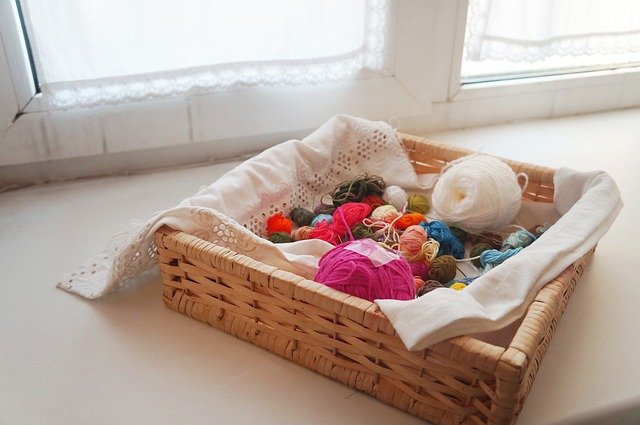
Add tools such as magnifying glasses, tweezers and combs
Offer a choice of attachments like tape, glue, staplers etc., as well as paper scraps, cardboard and other loose parts, including natural materials like sticks. Watch the magic happen!
There are many craft ideas that make use of yarn; this project preserves creativity and promotes self-regulation. However, remember the power of open-ended play and exploration when nurturing the ordinary magic of initiative!

In almost every variant of Cinderella, she ends up doing all the household chores while her stepsisters sit around lollygagging!
The great news is that young children LOVE to do these chores, when provided with the right-sized equipment and a little instruction and coaching.
Helping builds confidence, keeps the classroom (somewhat!) tidier, and…builds the executive function (EF) of working memory!
From dust bin to brain science gold mine!
Connecting new or revised classroom helper activities to the story builds interest. Spend a few minutes breaking each task down into a manageable number of steps for the Little Gold Star trainee.

For example, to maximize the EF of working memory, you could say and model:
Little Gold Star needs some help today! Here's how she wipes the table so it gets shiny and clean!
First, she puts the dry sponge gently into the bowl of soapy water.
Then, she squeezes the sponge out over the bowl.
She wipes the sponge in straight lines across the table and counts to 5.
Then she does it again! Your turn!
These simple activities help children to keep in mind the sequence of actions necessary to complete basic tasks.
This builds neural networks while kids feel competent and contribute to the classroom community (and maybe get the tables clean!)

In Little Gold Star, Arcia joins many fairy tale characters in a self-regulation practice that children love: she hides!
She hides as she peeks in the window at the fiesta she’s been told not to go to. Her stepmother tells her to hide under the table when the prince comes to find the girl with the gold star on her forehead.
Familiar games like Hide and Seek are great ways to help children practice self-regulation!
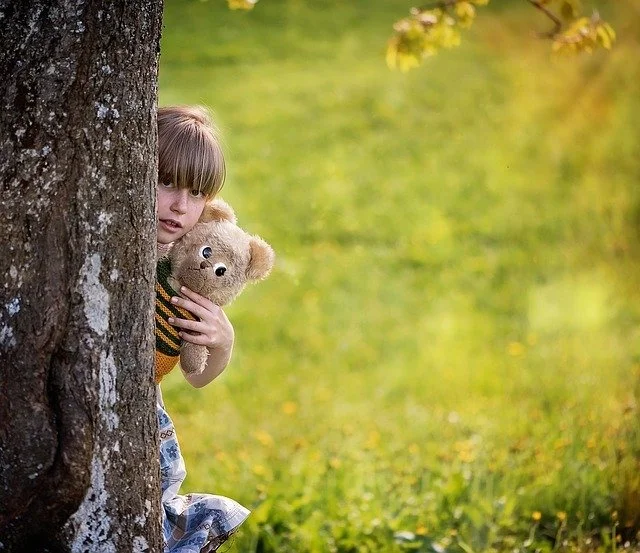
You can modify the game to match the story by having two or three children take turns hiding under classroom tables, while the other children hide their eyes (well…TRY to hide their eyes!).
Add to the fun and story connection by giving one of the “seekers” a cat puppet (either commercial or home-made out of a lunch bag)
Successful transitions are the gold standard of self-regulated children and SO HARD for many kids!
Reasonable expectations, making sure that children know these expectations and cues are stirred together to make transition magic. But children, especially when they are deeply engaged in play, tend to start tuning out such cues when they become too familiar.
Cues that actively engage children's imaginations work wonders to alert young players to a transition and encourage self-regulation.

After you share Little Gold Star, try introducing a cue taken from Hawk’s words to Arcia and her sisters:
“Lift… up… your eyes…Look…where…I fly…!”
This cue offers children who are less-regulated both the auditory and visual cues that a transition is coming, and they need to watch you to find out what’s next. Plus: it connects them to a magical tale and invites them to imagine!
Mary Had a Little Wait: Rhymes and Regulation
Waiting poses a huge self-regulation challenge!
Songs and fingerplays are one way to make the time go more quickly, and offer children the chance to co-regulate with their friends and teacher in a playful, engaging way.
With “frame songs” you can take a rhyme or song that the children are familiar with and switch up the words to tie into current stories or play schemes.
Try this adaptation of the familiar nursery rhyme, Mary Had a Little Lamb, based on Little Gold Star. The song can be chanted/sung during waits, and subtle hand motions can be added so that children’s active bodies can stay regulated too!
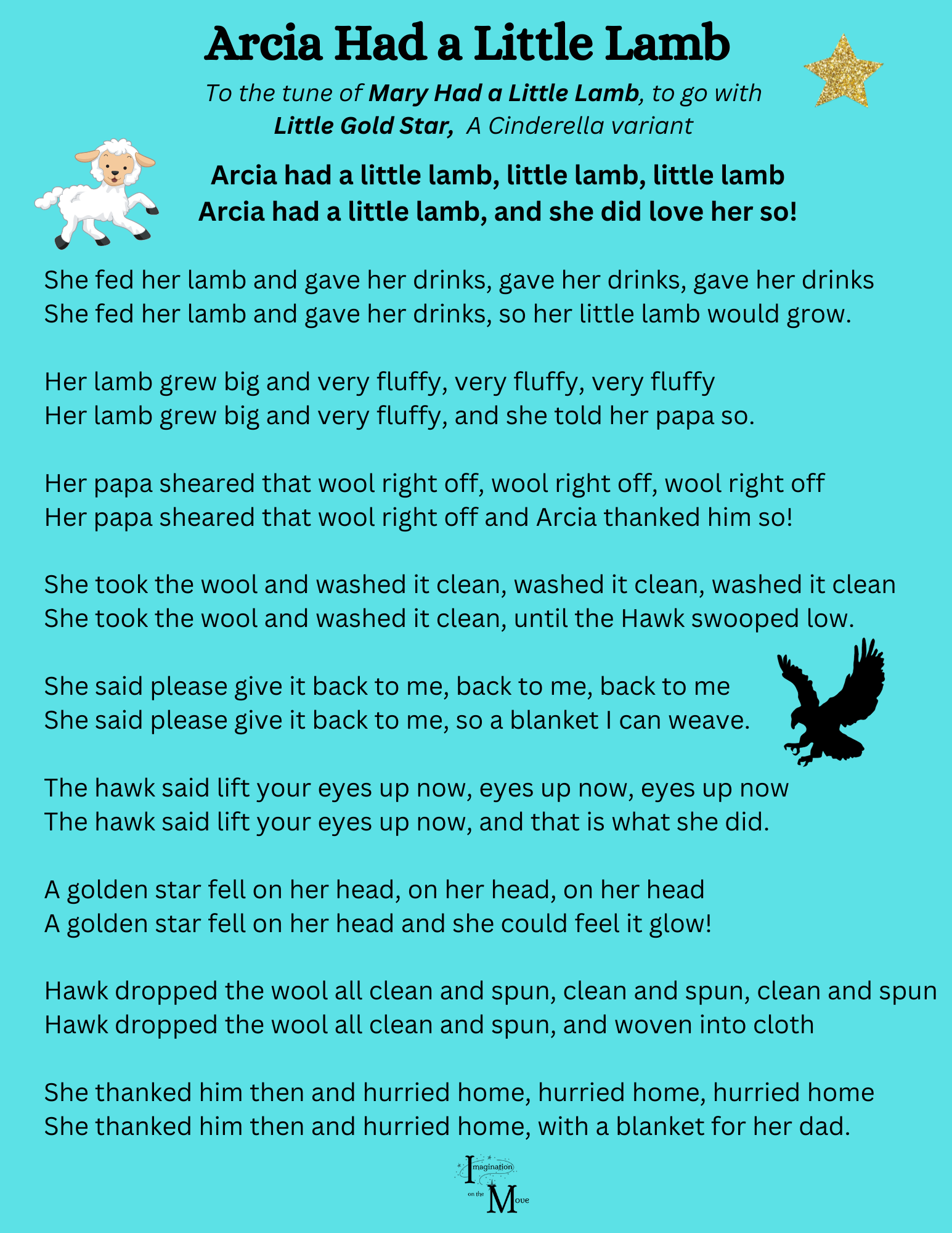
Arcia had a little lamb, little lamb, little lamb
Arcia had a little lamb, and she did love her so!
She fed her lamb and gave her drinks, gave her drinks, gave her drinks
She fed her lamb and gave her drinks, so her little lamb would grow.
(For lots more verses, click for free pdf download below!)
Want more Cinderella magic?
Check out our blog post to discover more tales of glass slipper resilience from around the world!